What Information Science Can Do for Opera History
Two INFO-trained researchers are building new tools to tell the story of opera in D.C.—and the performers and audiences who’ve shaped it
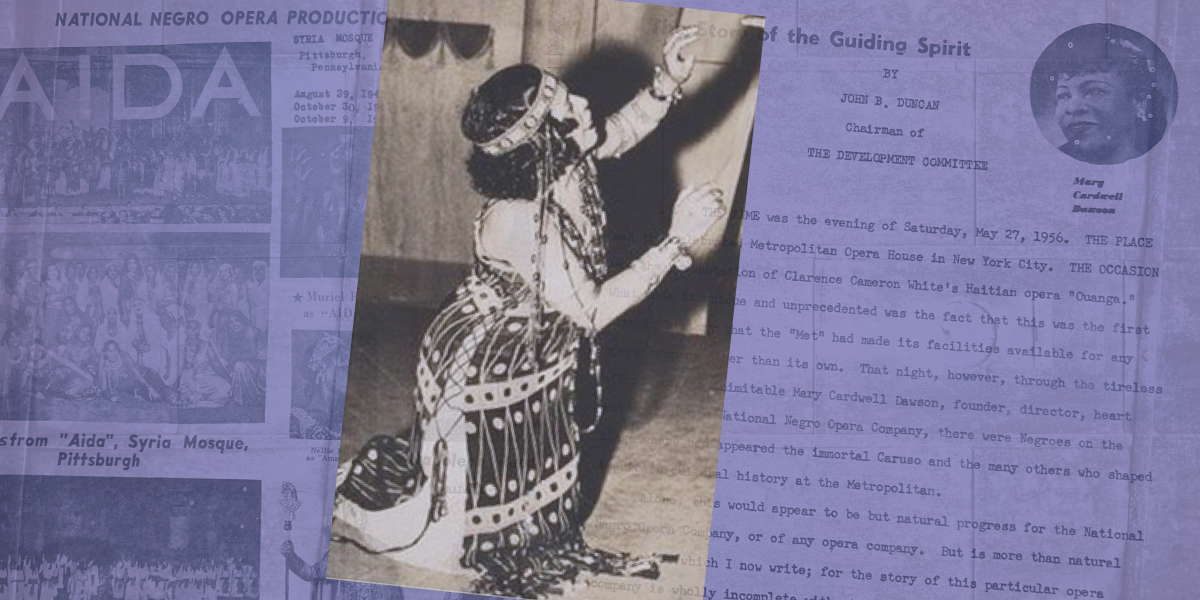
Jessica Grimmer, a lecturer at the University of Maryland College of Information (INFO), spent a recent weekend in Pittsburgh, working through the papers of Mary Cardwell Dawson and the National Negro Opera Company (NNOC) at the Heinz History Center. Founded there by Dawson in 1941, the NNOC was the first African American opera company in the United States—and it performed in Washington, D.C. for the first time in 1943, where it eventually found its home.
Image from 1959 booklet on the history of the NNOC, Mary Cardwell Dawson Papers, 1916-2001, MSS#440, Library and Archives Division, Senator John Heinz History Center.
That trip is part of a much larger story about opera in Washington, D.C. that Grimmer, co-director of the Center for Archival Futures at UMD, has spent years piecing together with Christina Taylor Gibson, Performing Arts and Digital Humanities Librarian at Towson University. The two met in INFO’s Master of Library and Information Science program, both arriving with Ph.D.s in musicology already in hand. What they bring to the project is not just expertise in opera, but a way of organizing and following evidence.
A New Kind of Bibliography
That combination is why their project, Opera on the Nation’s Stage: A Narrative Bibliography of Politics and Performance in Washington, D.C., looks nothing like a conventional scholarly bibliography. “The traditional bibliography in our fields is like an index,” Gibson explains. “It describes everything on a topic that you could find in secondary sources. That didn’t really work for us, so we twisted it a little bit.”
Grimmer describes the approach a little differently. “All that source material and just getting another list, we feel, is like drinking from a fire hose,” she says. “So we can act more as tour guides.”
Instead of cataloging everything, each chapter pairs a narrative overview with a case study grounded in archival research, then closes with a curated set of sources meant to help readers keep going on their own.
Mapping the Networks
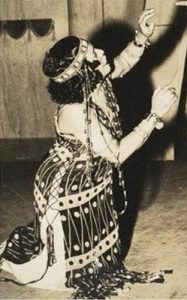
La Julia Rhea performing Aida with the National Negro Opera Company in 1943.
The book is only part of the project. Grimmer and Gibson are also building a digital companion, meant for classrooms as much as for scholars, that turns the book’s case studies into something readers can explore for themselves.
The NNOC is one of those case studies. The work recently received a Dena Epstein Award for Archival and Library Research in American Music—recognition that the company’s history is worth not just studying, but making openly accessible. “I love the idea of calling her this impresario of opera in the United States,” Grimmer says of Dawson, “because she was able to tap into such a network of not just people involved in opera, but also Black communities, first in Pittsburgh”—and later in D.C. To trace those networks, Grimmer is building a Wikidata knowledge graph mapping the performers, venues, and patrons behind the company, while Gibson develops mapping projects tracing how operatic influence moved into and out of the city over time.
Gibson keeps coming back to one piece of that record: photographs from the company’s first D.C. season in 1943, showing the huge crowds that turned out.
Those crowds have a recent echo. This spring, the Washington National Opera performed Scott Joplin’s Treemonisha at George Washington University, its first performance after leaving the Kennedy Center, and Grimmer and Gibson were both in the audience. The applause ran five minutes. People came dressed in the fashions of Joplin’s era.
“Opera can feel very elite,” Gibson says. “But the story that we’re telling… is about humans. Opera is the vehicle for telling a very human story about who gets included, who gets invited, what that feels like, who has access to elite culture and who doesn’t.” Grimmer and Gibson are betting that the more people who can find their way into that story, the richer it becomes.