UMD Team Works with Piscataway Conoy Tribe and Smithsonian to Bring Cultural Artifacts Back to Community
Working with the Piscataway Conoy Tribe, a team from INFO, ARHU, and MAPP is using 3D scanning to create replicas for community teaching and cultural preservation
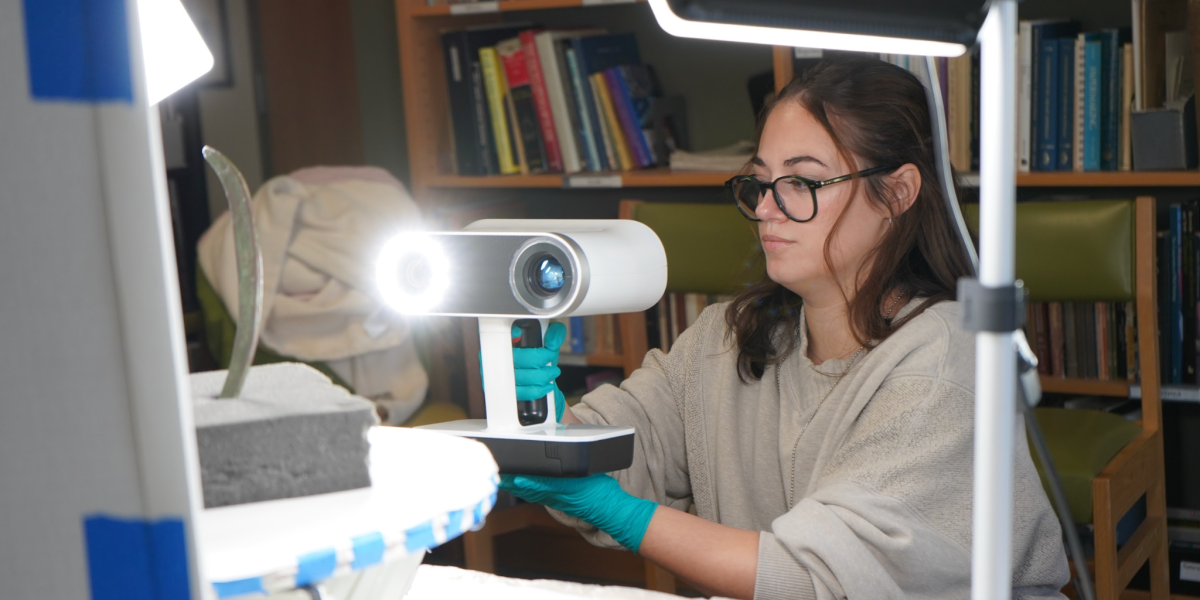
Abigail Hardy with a copper knife blade using the Artec LEO handheld scanner. Photo by Quint Gregory.
Deep inside a climate-controlled storage facility in Suitland, Maryland, hundreds of objects once used by the Piscataway Conoy Tribe sit in drawers and cabinets: pottery, tools, beads, and pipes collected by researchers and institutions in the 19th and early 20th centuries. Most Piscataway community members have never had the chance to see them.
That may soon begin to change.
The Smithsonian’s Museum Support Center, built in the late 1970s to house its vast off-site collections, now holds nearly 150 million objects from around the world. A collaboration among the University of Maryland, the Smithsonian, and the Piscataway Conoy Tribe is working to reconnect some of those objects with the public. Using advanced 3D scanning technology, the team is creating high-quality replicas of selected Piscataway artifacts, with the goal of returning those reproductions to the community that made them.
The project grew out of a partnership between Diana Marsh, associate professor at the University of Maryland College of Information, and Associate Professor Shelbi Nahwilet Meissner’s Indigenous Futures Lab (external link, opens in a new tab), based in UMD’s Harriet Tubman Department of Women, Gender, and Sexuality Studies (external link, opens in a new tab). They connected Quint Gregory, director of the Michelle Smith Collaboratory for Visual Culture (external link, opens in a new tab) in Department of Art History and Archaeology (external link, opens in a new tab), with Mario Harley, a leader in the Piscataway Conoy Tribe. Gregory brought the technical expertise.
Gregory’s primary method, photogrammetry, builds highly accurate 3D models from photographs taken at dozens of angles. From these models, replicas can be fabricated two ways: through additive 3D printing in wood or metal, or through CNC carving, where a cutting tool subtracts material from a block of native wood until it matches the scanned object exactly. The carved replicas are then hand-painted with natural pigments to match the original.
Eric Hollinger, a repatriation specialist and archaeologist at the Museum Support Center, has been a key Smithsonian partner throughout the effort. “We have seen an increased interest from tribes in 3D digitization and replication of objects for educational purposes,” he says.
First Steps
For Mario Harley, the project’s purpose is clear: to create a cultural center where Piscataway community members can teach with objects that carry the same weight, appearance, and tactile presence as the originals held by the Smithsonian. But before that vision could move forward, he needed to determine which objects mattered most.
Last summer, Harley and fellow Piscataway community member Zelda Proctor visited the Museum Support Center to walk through its storage bays and identify possible candidates. The visit quickly underscored a central truth of the project: institutional knowledge and community knowledge are not the same.
When a curator pointed to a strand of beads, Harley immediately recognized what they revealed about historical trade relationships. When the team examined an ax, he noticed right away that only the blade was original; the handle had been replaced at some point during the object’s long institutional life.
Inside the Storage Facility
Earlier this year, Gregory and a small team—including Marsh, INFO Master of Library and Information Science (MLIS) student Abby Hardy, and Stefan Woehlke, an assistant clinical professor in UMD’s Historic Preservation Program (external link, opens in a new tab) in the School of Architecture (external link, opens in a new tab) whose work centers on 3D digital documentation and community heritage—spent three full days at the Museum Support Center scanning the selected objects. Christian Cloke, associate director of the Collaboratory, contributed significantly to the model-making work that followed. For Hardy, a member of the Monacan Indian Nation in Virginia, the experience was more than academic. In the Smithsonian’s immense holdings, she encountered objects tied to her people.
“You have my community’s history,” she remembers thinking, “and the only way I’m even able to see them is because I’m doing academic work.”
Of all the artifacts scanned, one stood out most to her: a pipe with intricate relief carving dating to the 1600s or 1700s. “The amount of detail that went into it is outstanding,” she says.
Maria Vivar-Guzman, the other MLIS student involved in the project, describes the significance of the work plainly and powerfully: “These aren’t just historical objects. These are living pieces of cultural heritage.”
Both students are clear-eyed about the project’s limits: digitization is not a substitute for the original objects, nor for the ongoing work of repatriation. As Hardy says, “It still shows how much more work needs to be done.”
“I want students to have great experiences,” Gregory says. “I want them to develop useful skills. And I want it to be meaningful work.”
The project has brought together what each partner hoped for: students gaining real skills through meaningful work, an institution working to act responsibly toward the communities represented in its collections, and a community leader with a concrete vision now closer to realized. “I want students to have great experiences,” Gregory says. “I want them to develop useful skills. And I want it to be meaningful work.”