INFO Students Learn to Use AI With Records They Know Best
In a new series of Computational Archival Science courses, MLIS students build the skills to work with AI
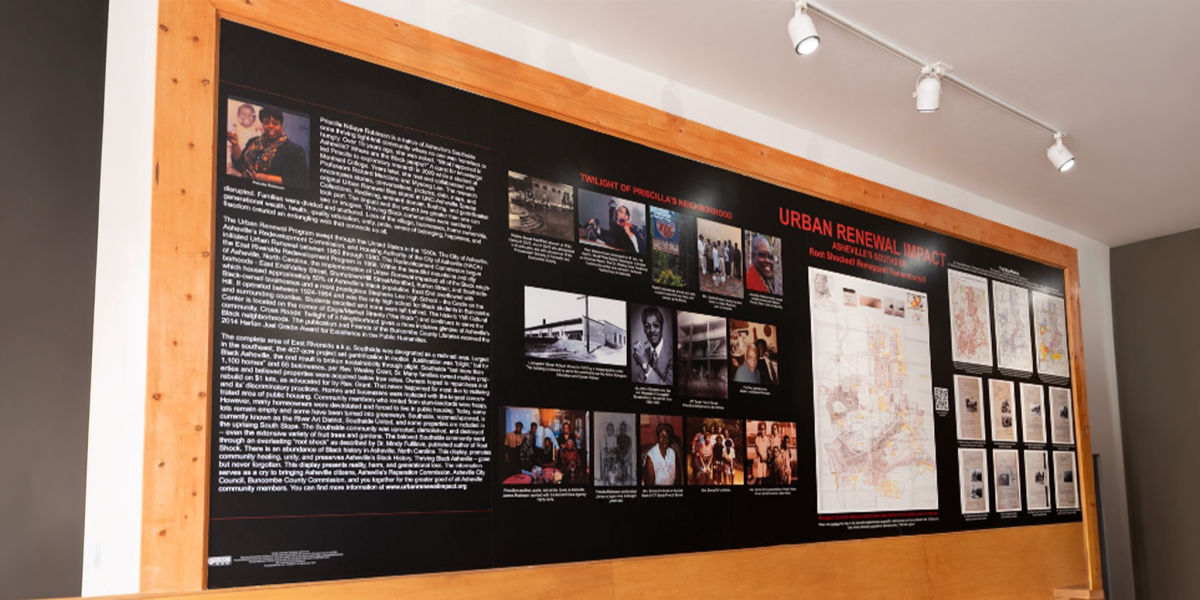
A mural in Asheville, North Carolina, depicts the history of the city's Southside neighborhood and the impact of urban renewal. Students in INFO's Computational Archival Science courses analyze archival records on that history.
When Tanya Torres ran a handwritten 1940 census through an AI model this summer, the names that came back weren’t strangers. Torres, a Doctor of Information Science student and former Master of Library and Information Science (MLIS) student at the University of Maryland College of Information (INFO), grew up with those names. Her family has lived in a small rural community outside Taos, New Mexico, for generations, and she recognized family after family on the pages, turning up new details she could share with her relatives, including that her grandfather was an enumerator for the 1940 Census.
The project was her final assignment in GenAI & Large Language Models for Library and Archive Collections, one of five courses in the University of Maryland College of Information’s Computational Archival Science (CAS) series taught by INFO Professor Richard Marciano. Marciano asked students to bring a collection that means something to them and test what these tools can and can’t do with it.
Kurosh Jafari, a former MLIS student who works at the Library of Congress, used Persian manuscripts from the African and Middle Eastern Division’s collections to create a StoryMap, as well as instructing an AI model to transcribe manuscript texts written in non-Latin scripts.
Students who know their material well, Marciano said, are better at catching when a tool gets things wrong. “You have to understand the content,” he said. “The human in the computational loop is essential.”
Learning on Records That Matter
The CAS series grew out of student demand. Three short trial courses in summer 2024 became full courses, and the series now includes five, designed for MLIS students: an Introduction to CAS and Python for non-coders, digital curation/data science, graphs, maps, and GenAI and Large Language Models.
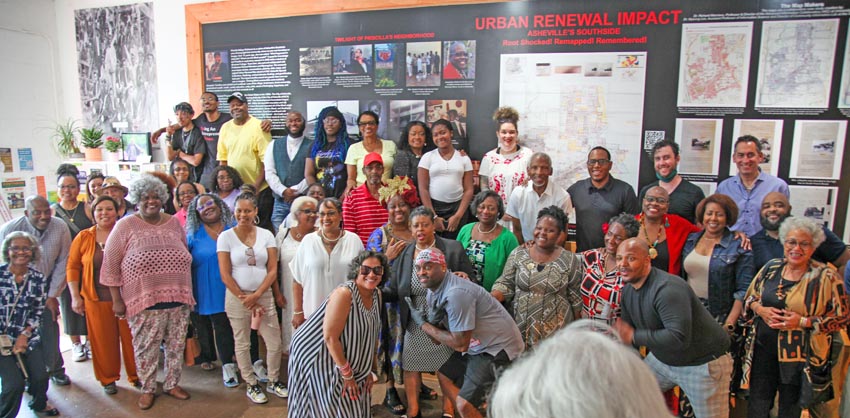
Residents and supporters gathering at the unveiling of the Southside mural at Grind AVL. Students analyze archival records on the urban renewal history it depicts.
Each course is built around real historical collections, such as urban renewal records from Asheville, North Carolina, that Marciano and earlier students and collaborators have studied for years. “It’s almost like one of these cooking shows,” Marciano said. “You walk students through a recipe, and then you pull out the finished dish that’s been in the oven all along.”
The goal isn’t to master any one tool, but to develop computational thinking skills: breaking a large task into smaller steps, spotting patterns, organizing data so it can be analyzed and designing a process a computer can carry out.
“Tools come and go. They’re ephemeral,” Marciano said. “But the concepts behind the tools, if you can describe them in a more general way—that has more staying power.”
From Skeptics to Informed Users
Many students arrive with limited experience using AI and negative impressions of it from social media. Stephanie Zager, who is pursuing a dual master’s degree in history and library science (HiLS), studies how food and cooking were used as evidence of heretical intent in Spanish Inquisition cases. “This class has completely changed my perception of and understanding of AI,” she wrote, “as well as the way I approach my own research.”
Others said working with real records made the technical work feel manageable, even without a coding background.
Melanie Belkin, a former MLIS student who does have a coding background, commented on how the network visualization course changed how she sees data: “Instead of viewing datasets as collections of records, I now see them as systems of relationships that can be queried and explored from multiple angles.”
A Field Taking Shape
Marciano and a small group of colleagues introduced CAS in 2016 to help archivists manage the growing volume of digital records. Interest is spreading: a new Institute of Museum and Library Services (IMLS) grant, led by INFO affiliate professor Jane Greenberg from Drexel University, with Marciano’s support, will convene a national forum on how CAS should be taught and practiced.
“It’s taken a little while,” Marciano said, “but this CAS initiative, which we started at the University of Maryland, is finally taking off with the hosting of the 11th IEEE Big DATA CAS Workshop, which will be held this December in Phoenix, Arizona.”
Employers are starting to notice. Marciano reviews job ads with students and sees more postings, including for traditional library roles, that ask for familiarity with coding, data, computational skills, and increasingly AI. “It’s definitely picking up steam and allowing our students to be even more marketable.”