Alumni Profile: How a Class Project Led an HCIM Alum to Epic Games
From Houseparty to Fortnite, Aashrey Sharma builds the features that help people connect through apps and games
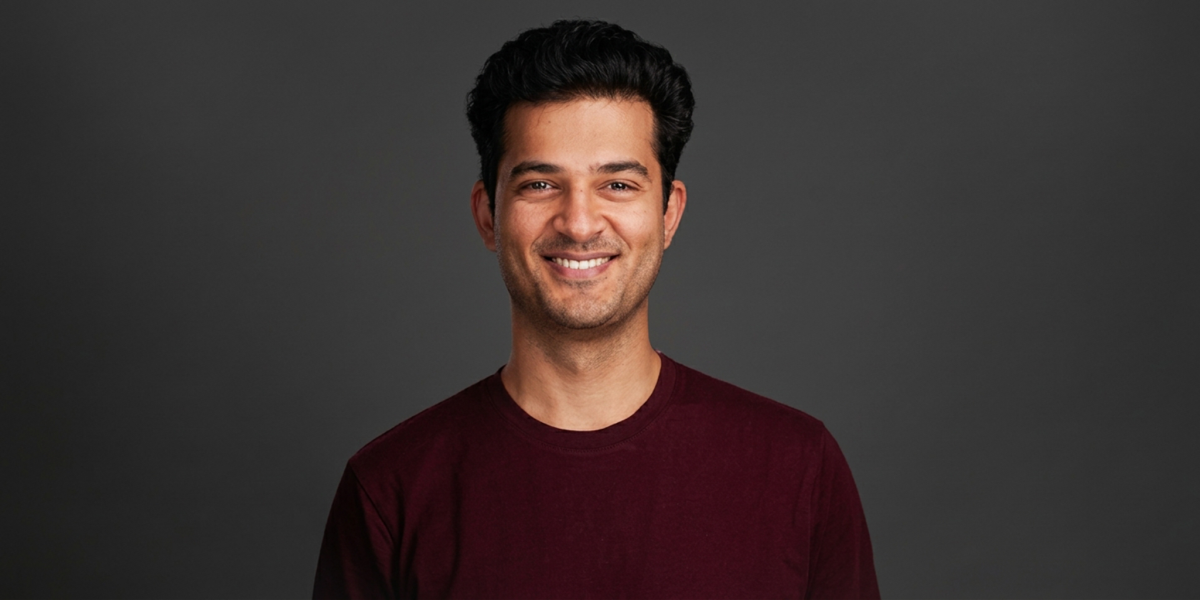
Aashrey Sharma, HCIM
Aashrey Sharma was always the new kid. His father was in the Army, and the family moved almost every year, so he attended more than a dozen schools before college. By the time he got to undergrad at Birla Institute of Technology and Science in India, he knew how much it meant to find your people fast. There, that started with choosing a dining hall. It was “a huge decision,” he said. “It’ll help you make all your friends because you eat together.” So when the school’s dining hall registration site froze whenever too many students picked the same hall at once, it was a problem.
After he complained about it enough, the classmate in charge of maintaining the website told him to fix it himself. A freshman at the time, he didn’t know how to program, but within a month he had a rough working version. He taught himself with Google searches, help from computer science friends, and Stack Overflow, a question-and-answer site for programmers. When the improved site launched, 2,400 students registered for the dining halls they wanted in 30 seconds. Before, it could take an hour. “I can’t describe how good it felt to see it work,” he said.
How INFO Shaped His Path
That moment set the pattern for his career. He said, “What is a good way to solve a problem, and what is the medium you do that in?” Sometimes the answer isn’t technology at all: stack your keys and wallet, and you won’t leave without both.
At the University of Maryland’s College of Information (INFO), where he earned his master’s in Human-Computer Interaction, Aashrey said his best classes let students shape their own work. An interaction design course, where the professor left project topics open, led directly to his first internship. A UX research methods course taught him rigorous methods. He wouldn’t use the full process in industry, he said, but it gave him the pieces for quick, targeted research, which he still uses.
His favorite was visual design with adjunct professor Justin Miller, who set a high bar for the final but let students pick the theme. Aashrey chose to redesign the video game Anthem, which needed work both visually and in its user experience. He appreciates “the fact that UMD made the space for a class like that.” He and Miller still stay in touch.
Later, an Epic Games recruiter called. The recruiter had played Anthem, run into the same problems, and liked his solutions.
He joined Epic’s social team in October 2020, straight out of graduate school, working on Houseparty, the group video chat app. With so many people stuck at home, it had become “almost like a primary means of communication.” Houseparty also had personality. “It was quirky, it was fun, it had a very casual style to it,” he said.
That focus on connection carried over to Fortnite, where Aashrey designs social features. The industry has learned that a great game won’t last if people don’t play it with their friends. So the job is to make it easy to meet the right people, find them again, and invite them to play or chat. “I know people use these to make friends,” he said. “It’s a material difference to someone else’s life.”
At Epic, he has moved from product designer to UX designer to senior UX designer, and the work has changed with each step. Today he spends less time in Figma and more time presenting ideas and getting teams behind a shared vision. That’s the hardest part of the job, he said, and the most rewarding.
Advice for Students: Intuition Over Tools
Aashrey thinks UX has become too focused on tools and formal processes,. As AI improves and becomes more prevalent “What will become super important is your intuition and your taste,” he said. To build that, he suggests an exercise: take any random problem and practice solving it five different ways. He also recommends experimental electives. He took a 3D modeling class that had little to do with UX but taught him Blender, a free 3D graphics program.
His top recommendation to students is to “be very familiar with AI,” and he follows his own advice. In his free time, he is building skills that let one AI agent manage others, so that 20 small edits, like nudging buttons a couple of pixels, run at once instead of one by one.
Away from the computer, Aashrey lives close to the water in Seattle, where he takes long walks, hikes once or twice a month, and meets friends for Korean barbecue every week. It’s easy to stay indoors, he said, so he makes a point of getting out and building community.
It’s a big change from his childhood. After years of moving, he has lived in Seattle for four years. “If I cross five, it’ll be the longest I’ve ever lived in a place,” he said.